
KIA extends electric range with EV3

AS KIA continues to climb the sales charts, seeking a permanent position in the top five nationally, the company is not putting all its eggs in one design basket.
While seasoned performers like Sorrento, Carnival and Sportage offer a mix of internal combustion engines, KIA is developing a sizable electric vehicle (EV) fleet.
Latest is the EV3, a small-medium SUV offering boxy, yet appealing, looks, with a strong focus on geometric shapes.
The designers dug deep into their box of shapes, particularly the stretched octagons featuring front and rear, close examination reveals more hiding in plain sight.
The front is a love it/hate it affair, it was a little too ‘space shuttle’ for my tastes, not ugly, but without a grille or visible air intakes, it looks like a heat shield primed for atmospheric reentry.
Also divisive are the ‘double diamond’, frisbee-like, alloy wheels, they aren’t terrible and are undoubtedly aero-effective, I just love spokes and star shapes.
The whole package is distinctive, kudos to KIA for trying to stand out from the pack in an era when copy-cat designs seem to dominate.
I do love the boxed guards, such a 1970s Group 5 sports car look, I will take those every day, they allow the front and rear track widths to be stretched as much as possible for better stability.
The roof is flat, but angled down towards the rear, it draws the eye, making the rear quarters less bulky.
Our test car was the base ‘Air’ variant which meant black plastic wheel arch extensions, breaking up the body line and making it look smaller, while protecting against stone chips.
KIA calls the front the ‘Tiger Face’, I don’t quite see it, the recessed headlights and slimline daytime running lights (DRLs) do help define the bonnet line.
Inside, the EV3 is comfortable, but looks and feels flat, like it is two-dimensional, with no sense of depth, it doesn’t feel cheap or under done, the advantage is it increases the passenger space with none of the panels pushing into the cabin.
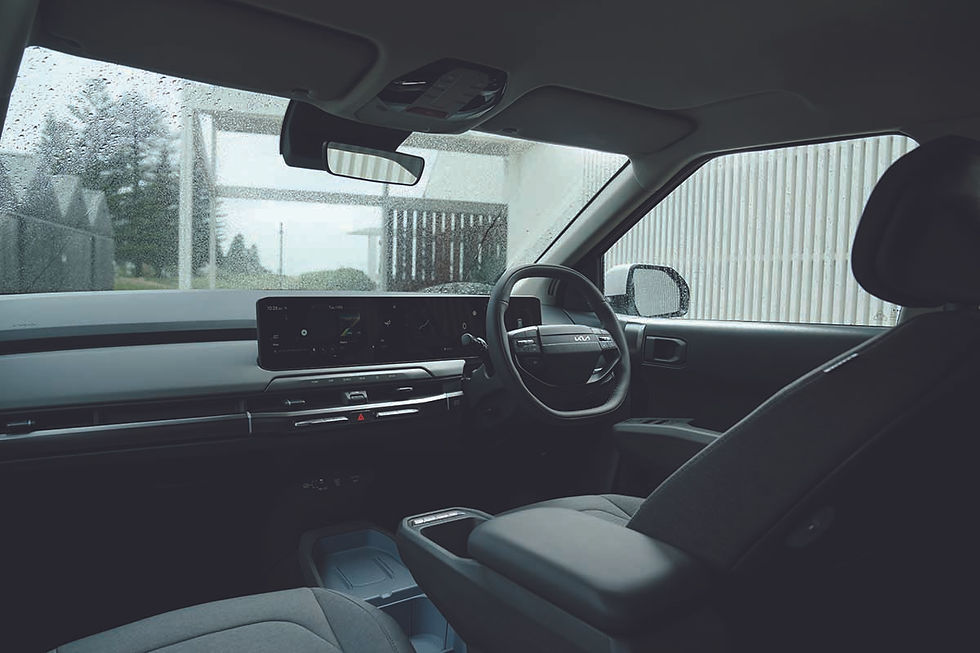
As the base model, we got two-tone cloth trimmed, manually adjustable, front seats, saving weight, they were comfortable but without much lateral support.
We had the large diameter two-spoke, unheated, steering wheel with height and reach adjustment, as well as automatic dual-zone climate control.
The twin 12.3” displays, touchscreen for the centre stack, are common across the range, the base gets AM/FM/DAB radio with bluetooth and wireless Apple and Android connectivity, although nominally two distinct screens, they are actually a single unit with split-screen displays.
A row of physical buttons under the screen, including a roller-style volume control, allow quick access to the major functions, with greater control via the screen.
The usual centre console is a double-stacked tray with a smaller storage box, good for wallets and keys, under the armrest, along with a pair of cupholders, and a QI wireless phone charging pad on the lower level.
While everything is functional, my biggest complaint is a sterile feel, that ‘space shuttle’ effect again, there is no emotion in the design, it works perfectly, but without engaging with occupants.
As is the norm, the steering wheel face has controls for the major functions, audio, telephone and cruise control, as well as the driver-selectable instrument panel displays.
In that respect, the EV3 is a mostly ‘normal’ driving experience, you get in, foot on brake, push ‘START’, the ‘READY’ signal comes up and you are good to go.
The gear selector is on the right side of the steering column, mounted on a separate stalk, twist up and down for DRIVE and REVERSE, push in for PARK, the steering wheel paddles control the amount of regenerative braking, from ‘barely there’ to maximum effort.
This activates ‘i-pedal’ mode, the car is driven on the accelerator, push to go, lift to stop, the magnetic brakes do all the work, generating electricity at the same time.
It takes a little getting used to, but after an hour or two most people adapt and it becomes second nature, as well as energy efficient.
There are five selectable drive modes covering Normal, Eco, Sport - good for fast getaways, but watch the power drain - Snow and a ‘My Drive’, where the EV3 learns your driving style and tailors throttle and braking to your inputs.
KIA completed an Australian ride and handling program, it paid off, there is a degree of compliance in the suspension often missing from EVs.
It is not pothole-proof, instead there is a sense of connecting with the road, a predictability allowing the driver to pick a line, confident the EV3 will follow.
With 150kW and 283nm, it is not massively powerful and eases sedately, for an EV, to 100km/h in 7.5 seconds, the speed building effortlessly through the single-speed transmission.
This step-less progress is good for first time EV drivers, you quickly adapt to the ‘push hard, go hard’ nature of the car.
With 375kg of battery under the floor, the EV3 is planted to the road, the low centre of gravity allowing it to be pushed through corners with less understeer than a conventional front-wheel-drive.
Another function of the underfloor battery is a flat floor in the luggage area, although the sloping tailgate reduces available height it will hold a stroller - I have grandchildren! - but it takes a lot of room, shopping is packed tetris-style in the gaps.
While the EV3 is a good car, not just a good EV, for me, the lack of engagement is its downfall, KIA has made some wonderful cars in the last 10 years that drive well, but also interact with occupants, this is the EV3’s weak point.
Worth a drive if you want reliable and effective driving, and many people do, but it is not an enthusiast’s car.


Comments