
Mazda refreshes big wagon range - but is it too much of a good thing?
- Gary Worrall
- Jun 11, 2025
- 12 min read

AS one of the first to really embrace the big SUV trend, with a total move towards family-sized wagons offering a choice of two- and all-wheel-drive, Mazda not only got a headstart on others, but it reinvented itself from its history of smaller, sporting, cars into a serious mainstream manufacturer.
While it was sad to see the end of some of those 'specialty' cars, the reality was the market had moved away from them, and the demand was for bigger, taller, and yes, to an extent, clumsier, wagons.
Thankfully a true automotive gem has survived, in the form of the MX-5 sporty, but for the rest, Mazda has moved with the times, and is building what people want to buy.

EXTERNALLY, the 'big' CX wagons, the -70, -80 and -90, all look similar, and this is perhaps the root of the issue, while they all look good, there is a feeling of them essentially being clones of one another, making it hard to tell them apart at a distance.
Most noticeably, there is the now traditional Mazda long bonnet look, these things are huge, we joke about them being like an aircraft carrier flight deck, but there is an element of truth in the humour, they are immense, with enough square metreage to allow them to be subdivided under town planning rules.
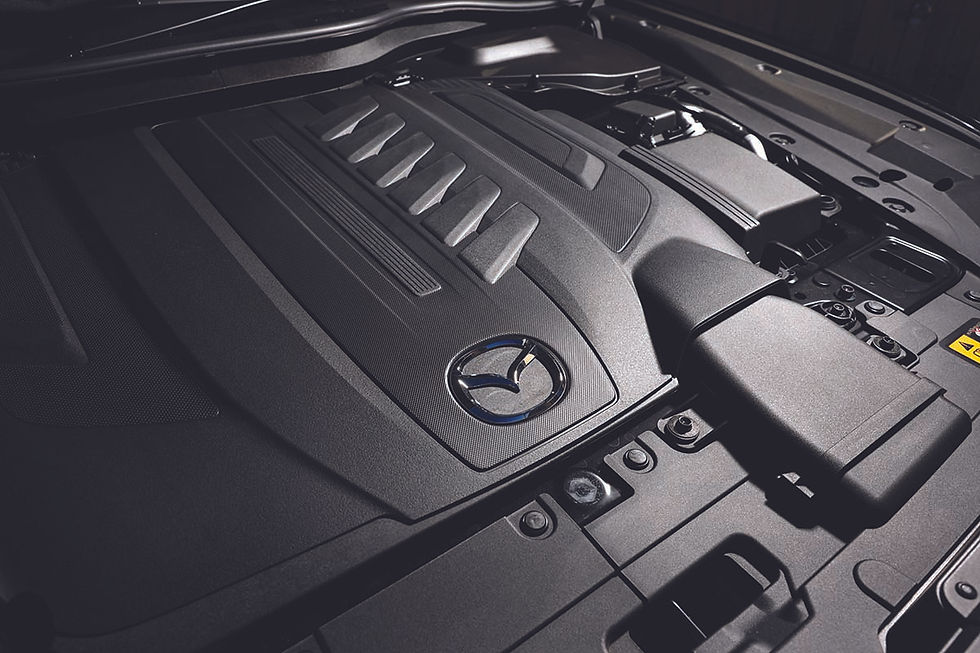
The long bonnet is there for a reason, with Mazda offering the choice of petrol and diesel inline six cylinder engines, the D50e turbodiesel and the G50e petrol turbo, both displacing 3.3-litres, and both pushing out impressive numbers.
The D50e diesel produces 187 kW @ 3,750 rpm and 550 Nm @ 1,500 – 2,400 rpm, while its petrol-fired sibling creates 254 kW between 5,000 – 6,000 rpm and 500 Nm across 2,000 – 4,500 rpm, both using Mazda's 'mild' M Hybrid system.
While it is not displeasing to the eye, the problem is it puts the driver a long way from the front of the car, and when you pair this with Mazda's other favoured design element, the sharp, vertical, nose section, what could be described as being guillotined off the front of the car, you can easily lose track of how close you are to a low obstacle, like a parking bollard.
This is exacerbated by the elevated driving position, courtesy of them being high-riding AWD SUVs, while it is nice to have a 'command' driving position, it is also nice to know where your front end finishes in close proximity to obstacles.
Yes, this is offset by having forward-facing cameras and sensors in the front bumper, but with the tightness of modern parking spaces, it would just be nicer to have a little more direct eye contact, if only to silence the little voice yelling 'too close, too close'.
Otherwise, the CX wagons are pleasant to the eye, not gorgeous, but not terrible, everything is proportional, you understand you are looking at a big car, but again, this is part of what feels 'not right' about the cars, stand back about 20 metres, say the length of a cricket pitch, and they take on a sameness that makes visual identification difficult.
We have spoken (written) before about picking your car out in a crowded parking lot, this takes it to a new level, of not being able to quickly pick it out when you are at the dealership.
Aside from a longer tail section on the seven seat options, the bodies are virtually identical, with no distinguishing characteristic to say 'I am a -70' or 'I am an -80', and I think this is the biggest challenge facing the big CX range, you really can't tell them apart.
This is more to do with buyer psychology, there is no real fault with the cars, but having shelled out well north of $60k for a new car, as humans, we like to be able to show it off, and if our car looks the same as the neighbour's (lesser) version, then we tend to feel a little disappointed, what is known as 'post-purchase dissonance' (see, I didn't sleep through all of my marketing lectures at Uni!).
Holden experienced a version of this back in the early 1980s, when the 1982 range of Commodore, Camira and Gemini all looked like they had been cloned, with just the variance in size to differentiate them - Commodore buyers weren't happy their new car looked too much like the other cars in the passenger line-up.
As a result, there was clear visual distinction between the subsequent models, so it was clear you had bought a Commodore, or a Gemini, rather than confusion at 20 paces.
So, back to the CX range, this is one challenge Mazda faces, a little like the motor racing analogy that the first person you have to beat is your team mate, for the CX models, the first car they have to see off is their stablemates, a hard ask when they look so much alike.


The similarities continue with the dash layout, CX-70 (left) and CX-80 (right) are virtually identical, except for the trim materials and colours
REGULAR readers will know I am a fan of Mazda products, one of the first cars I ever tested was the original Mazda 6 hatch, and we had a Mazda 1500 SS when I young (can't say little, legend has it I was never small), so yeah, there is a bit of love for the brand residing in me.
With that necessary admission made, I will say with clear conscience I generally enjoy Mazda interiors, ok, sometimes the colour choice may not be totally practical - the 6 GT diesel's white leather springs to mind, beautiful car, glad I didn't have to clean it! - but they always had a touch of luxury, with sportiness thrown in when appropriate.
The fit and finish is always up with the best the Euros could offer, with a bit of tech added to remind you it is Japanese, the materials are high class, the whole feel is generally of being cosseted or cocooned from the outside world.
Good news, the CX wagons are worthy keepers of this design flame, seats were sumptuous, just enough soft padding to make you feel totally at home, but if the going got interesting, they were solid and supportive, you know you are secure inside them.
We had a few different trim levels, including the range-topping Azami models, and boy, they are great places to while away a few hours behind the wheel, the longer you were in the car, the better it got.
Even buyers of the mid-spec versions are treated to a decent level of comfort, with thickly cushioned seats enveloping you, Mazda manages to not only make them comfortable, but also supportive should you choose to explore the outer edges of the handling.
Look for lashings of leather, yep, the real deal, as nice as the synthetic version can be, there is nothing quite as welcoming as genuine leather, with a variety of colour tones, again, depending on the specification, my fave was the tan leather on the SP option for the range-topping Azami CX-90, it was as good as anything I have sampled in the past.
When it comes to in-car tech, Mazda goes just as hard as the competition, with plenty of gizmos and gadgets to choose from, even the base Touring versions get an 8-speaker BOSE audio system, along with a 10"x2.5" HMI (Human Machine Interface - central display in plain language) screen.
This grows to a 12"x3" screen in the higher-spec GT and Azami variants, which also top out with a 12-speaker BOSE audio system, complete with sub-woofer, perfect for getting the party started!
As if in answer to my supplications, Mazda has made an Active Driving Display, otherwise known as a Heads-Up Display (HUD) standard on the CX-70 and -90, making driving easier and safer, removing the need to glance down at the instrument display.
Yes, I bang on about it, but once you have used a HUD, losing it feels like a backward step, I acknowledge some tech can be a gimmick, something to draw the punters in, but HUD is genuinely improving safety, by allowing you to focus on driving, and not having to sweat the small stuff.
The Mazda version does a good job, seeming to float above the bonnet, giving you the information you need, like speed limit signs, thanks to the forward facing cameras, very handy in this age of ever-changing speed zones, making it less likely to get a photo in the mail of your unintentional misdemeanours.
Other goodies include the now obligatory CarPlay and AndroidAuto, as well as inbuilt navigation, bluetooth telephony and audio, along with DAB radio and multi-zone climate control with dial-a-temperature across the car.
Add to that heated seats, with cooling available on the higher-spec versions, as well as steering wheel heating, and demisters for the door mirrors, along with front and rear screens, and you get the picture, the CX wagons are well equipped.
The big ticket items are hidden from sight, the extensive suite of safety systems, with a library of acronyms, all laying in wait until it is time for them to work their magic, although, to be honest, it would be better for all concerned if they were never needed.
Starting with the basic pieces, ABS brakes, auto headlights, and Mazda Responsive Cruise Control, their version of adaptive cruise control, the list then gets more interesting, with the antilock brakes getting emergency brakeforce distribution, which varies the stopping power to the wheel, or wheels, that need it most to stop you in the shortest time the human body can tolerate.
Throw in seatbelt pretensioners, multiple airbags, which only deploy as much as needed, based on deceleration, direction of travel and information from a host of other computer-controlled sensors, like steering angle and wheelspin and slip to decide how bad things are looking.
Then there are the high-spec Azami variants with adaptive lighting, which use light sensors to adjust the volume and direction of light from the standard LED headlights, for example the left side lights will stay on high beam, pointing to the road shoulder, while the right side drops to low beam to avoid dazzling oncoming traffic.
Anyone who has experienced a random animal wandering or hopping from the road shoulder on a dark road will appreciate the ability to maintain maximum lighting, while being respectful to other road users.
Add to the list sensors looking for pedestrians, emergency brake assist detecting other cars suddenly braking in front of you, stability and traction control for the All-Wheel-Drive system and you get the idea, these cars have your safety front of mind.
There are also all-round camera views for parking and squeaking through tight spots if you do venture off the beaten track - more on that later - as well as parking sensors to give you warning of just how close those parking bollards really are.
While some may question the need for, or even the wisdom of having these systems, it is worth remembering that many are required by Australian Design Rules (ADRs), which leaves the manufacturers with no wriggle room in regards to fitting them or not.
Instead, they have to have them, then the big job is making them work as efficiently as possible, to achieve the all-important five stars when the vehicles are tested under the New Car Assessment Program (NCAP), either here or overseas.
While the wagons are clearly well equipped, the problem is they are virtually clones of themselves, with no easy way from inside the car to tell them apart.
Absolutely, they are roomy, comfortable and well built, great to be in, all admirable qualities, but when there is this 'sameness' between them, they tend to blur into each other, leading to asking 'what's the difference?'.
With the main changes happening from the B-pillar back, there is a very real risk of buyer confusion, or worse, cannibalisation of buyers, who go to look at one model and finish up with a virtually identical car, making them compete with themselves for sales, rather than being solidly differentiated from each other.
THE comparisons continue when you get on the road, with the same drivetrains employed across the three models, the differences are far outnumbered by the similarities.
Unfortunately, this means as well as sharing the same positives, they also share the same downsides, in this case the 8-speed automatic.
While it works well enough once the car is moving, there is significant inertia in the driveline, despite the healthy power outputs of both engine choices, which means you need to give the car a big bootful to get it moving.
The problem then is the CX launches forward, jumping to 15-20km/h in no time at all, and if you are in stop-start traffic, which is an all-to-common situation these days, then you are straight on the brakes, trying to bring it all to a stop.
The end result is a series of lurching and lunging stop-starts, which really detracts from the whole driving experience.
There is also a noticeable 'thunk' when the car does stop, and it returns to first gear, when it first happened, we put it down to a one-off situation, however it manifested itself frequently, and in all the different wagons we drove.
Once rolling, the transmission improved, with pleasant shifts through the higher gears, and with so many ratios to choose from, fuel consumption, not surprisingly, evened out, especially on long runs at highway speeds.
This was impressive, not just because of the mass of the CX wagons, but also the large frontal area of the vertical grille structure, unlike sleeker, more aero-friendly frontal aspects of similar cars, the CXs have to punch a sizeable hole in the air, which takes more energy.
The ride was comfortable, aided by massive rims, ranging from 18" all the way to 21" diameter on the CX-90 Azami, the suspension worked well to absorb the worst our roads could throw at us, although there were still thumps from 'downstairs' when it was impossible to miss every pothole.
The long wheelbase also helped with absorbing a lot of the bumps and corrugations, there was enough time between the front hitting a bump before the rear axle arrived to allow the suspension to react, rather than dealing with a double impact, which can happen in shorter wheelbase cars.
Mazda has also included a rear-steer function, where the inside rear wheel is lightly braked on turn-in - another function of the intelligent ABS system - this helped reduce the amount of steering lock needed at the front end, making the ride smoother.
Steering is direct, with no discernible free play at the straight ahead position, as soon as you turn the wheel, the electric power steering begins to react, with the added bonus there is no 'drag' on the engine, which also helps fuel efficiency.
While accurate and predictable steering is always a good thing, the CXs are not fans of being thrown at corners, a combination of high ride height and a lot of mass means they can feel ponderous and lumbering if you try to get to enthusiastic through the twisty bits.
In fairness, Mazda has never tried to claim the CXs as big sports wagons, you want crisp handling and the ability to carve your way through a succession of switchback corners, well, that is why they make the MX-5...
You just need to realise you are sitting in something with a high centre of gravity and a couple of tonnes of kerb weight, and drive it accordingly, the CXs can make their way around a tight corner, but carry too much speed, and you will feel the body roll.
With rear-biased All-Wheel-Drive, the CXs do okay on loose surfaces, and there are programs to exploit the computer smarts for controlling the outputs and braking to maximise off-road ability, which allows you to go further than you might think.
Mazda claims around 200mm of ground clearance for the wagons, which is decent, the biggest challenge are the overhangs, especially at the rear, which can cause scraping at both ends when picking your way through broken terrain.
The big rims can help in this regard, allowing you to 'walk' over corrugations and washouts, it just takes a little care, combined with a drop in tyre pressures, to allow the tyres to compress as they climb in, out and over obstacles.
While the standard tyres are very much wide footprint road tyres, not chunky, aggressive tread pattern off-roaders, reducing the pressure to around 23-25psi will take you a long way on rough tracks, and don't be afraid to drive slowly, take your time and enjoy the drive, and surprise yourself at some of the places you will go.
That said, no, you will not go as far as a dedicated heavy duty off-road vehicle, but don't be told you can't do it, just take the time to assess the track, be ready to take an alternate line, and not too proud to back out and turn around if you feel out of your depth.
IN isolation, the CX wagons, the -70, -80 and -90, are all big, impressive wagons, with outstanding build quality, brilliant six-cylinder engines, good general ride and handling qualities, and well-appointed interiors, and they are spacious too boot.
The problem is they are so alike as to be virtually the same car, which makes it almost impossible to know what you are driving from the inside, they are so close to being identical triplets they can almost finish each others sentences.
While this can be a credit to the designers, that they have managed to create three versions of the same car, it is also a challenge to encourage buyers to see them as three distinct models, with their own attributes and capabilities.
If this doesn't happen, then Mazda is faced with a scenario where the CXs will be competing with themselves for sales, and ultimately customers become unsure of which car they are buying.


Comments